
Many Middle Passages: Forced Migration and the Making of the Modern World – Emma Christopher, Cassandra Pybus & Marcus Rediker (Eds)
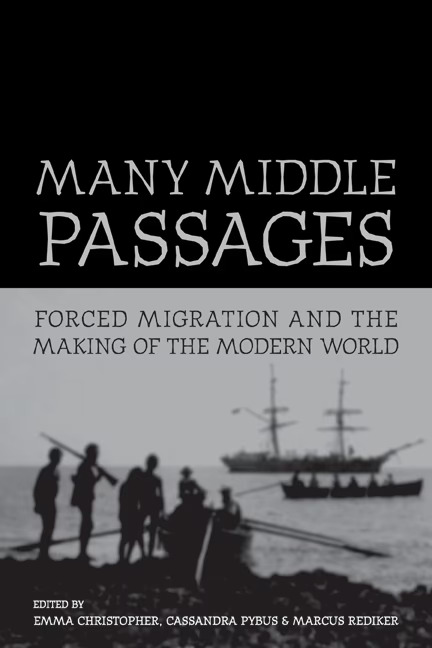
Editor(s): Emma Christopher, Cassandra Pybus & Marcus Rediker
Publisher: University of California Press
Year of Publication: 2007
Print Length: 274
Genre: Non-Fiction / Migration & Refugee Studies
Area: Africa, China, East Africa, Ireland, The United States of America (USA)
People: American, Chinese, Irish, The Africans
Topic: Abolition, Children & Childhood, Civil War, Labor & Contract, Migrants, Refugees & Forced Migration, Slave Trade, Woman and Femininity
This groundbreaking book presents a global perspective on the history of forced migration over three centuries and illuminates the centrality of these vast movements of people in the making of the modern world.
Highly original essays from renowned international scholars trace the history of slaves, indentured servants, transported convicts, bonded soldiers, trafficked women, and coolie and Kanaka labor across the Pacific, Indian, and Atlantic Oceans. They depict the cruelty of the captivity, torture, terror, and death involved in the shipping of human cargo over the waterways of the world, which continues unabated to this day. At the same time, these essays highlight the forms of resistance and cultural creativity that have emerged from this violent history.
Together, the essays accomplish what no single author could provide: a truly global context for understanding the experience of men, women, and children forced into the violent and alienating experience of bonded labor in a strange new world. This pioneering volume also begins to chart a new role of the sea as a key site where history is made.
Table of Contents
Acknowledgments
Introduction / Marcus Rediker, Cassandra Pybus, and Emma Christopher
1 The other middle passage: The african slave trade in the indian ocean / Edward A. Alpers
2 The east african middle passage: David livingstone, the zambesi expedition, and lake nyassa, 1858-186 / Iain McCalman
3 The iranun and balangingi slaving voyage: Middle passages in the sulu zone / James Warren
4 The voyage out: Peter kolb and voc voyages to the cape / Nigel Penn
5 Bound for botany bay: John martin’s voyage to australia / Cassandra Pybus
6 “The slave trade is merciful compared to [this]”: Slave traders, convict transportation, and the abolitionists / Emma Christopher
7 Convict passages in the indian ocean, c. 1790-1860 / Clare Anderson
8 After slavery: Forced drafts of irish and chinese labor in the american civil war, or the search for liquid labor / Scott Reynolds Nelson
9 LA TRATA AMARILLA: The “yellow trade” and the middle passage, 1874 – 1884 / Evelyn Hu-DeHart
10 “A most irregular traffic”: the oceanic passages of the melanesian labor trade / Laurence Brown
11 LA TRAITE DES JAUNES: Trafficking in women and children across the china sea / Julia Martínez
Afterword: “all of it is now” / Kevin Bales and Zoe Trodd
Postscript: GUN – SLAVE CYCLE / Marcus Rediker
Appendix
Contributors
Index