

Migration, Accommodation and Language Change – Bridget L. Anderson
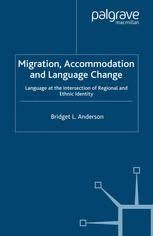
Available Online for Members
Borrowable for Members
Author: Bridget L. Anderson
Publisher: Palgrave Macmillan
Year of Publication: 2008
Print Length: 214 pages
Genre: Non-Fiction / Migration & Refugee Studies
Area: Europe, The European Union (EU)
Topic: Ethnography, , Humanitarian Action & Humanitarianism, Humanity, Migrants, Refugee Economies, Refugee Livelihoods, Refugees & Forced Migration, Transit Country
This work marries qualitative ethnographic methods to quantitative acoustic methods. The analysis describes how internal and external factors in phonological change differ and demonstrates how these two forces interact to structure the phonological systems of Appalachian and African American Southern Migrant speakers in the Detroit, Michigan area.
Table of Contents
List of Figures
List of Tables
Acknowledgments
1 Introduction
2 Empirical and Theoretical Background
2.1 American English vowel shifts in progress
2.1.1 The Northern Cities Chain Shift
2.1.2 The Southern Shift
2.1.3 African American vowel systems
2.1.4 /ai/
2.1.5 The high andlower-highback vowels /u/
and/S/11
2.2 Models of change 13
2.2.1 Internal and external factors in language
change 13
2.2.2 Language ideology: An overview 14
2.2.3 Dialect contact 16
3 The Sociolinguistic and Demographic Context for the
Study 18
3.1 Research site and demography of the area 18
3.2 History of migration to southeastern Michigan 21
3.2.1 Appalachian White migration to Detroit 21
3.2.2 African American migration to Detroit 24
3.3 Appalachian Whites and African American
Southern migrants in the Detroit area 26
3.4 Appalachian English 28
3.4.1 In the Southern Highlands 28
3.4.2 In Southeastern Michigan 31
Contents
3.5 African American English
3.5.1 In the South
3.5.2 In Southeastern Michigan
3.6 Midwestern urban Whites
4 The Pilot Study
4.1 /ai/
4.1.1 Participants and methods of analysis for the
pilot study
4.1.2 The patterning of /ai/
4.2 Acoustic analysis of// and /æ/ for five
Appalachian White women, five African American
women, and five Northern White women 39
5 Field Techniques and Acoustic Methods47
5.1 Study design47
5.1.1 Speaker selection 47
5.1.2 Participant observation and
ethnography49
5.1.3 Data analysis 50
5.1.4 Individual first versus community
first 51
5.2 Field methodology 53
5.2.1 Participants 53
5.2.2 Fieldwork anddata collection 55
5.2.3 Recordingprocedures 57
5.3 Acoustic analysis 57
5.3.1 Temporal locations and measures 58
5.3.2 Spectral measures 58
5.4 Spectral comparisons 59
6 The High and Lower-High Back Vowels65
6.1 Analysis of /u/∼/i/ and/S/∼/G/distances at
midpoint and offset 66
6.1.1 Methods for the statistical analysis 66
6.1.2 Descriptive overview of frontingpatterns 67
6.1.2.1 African American, Appalachian,
and Midwestern White groups68
6.1.2.2 African American and Appalachian
speakers 69
Contents ix
6.1.3 Statistical analysis ofF2 distances75
6.1.4 Summary and significance of the F2 distance
results 79
6.2 Context effects of consonants on preceding
vowels80
6.2.1 Effects offollowing alveolar consonantal
context on vowel spectra 81
6.2.2 Effects of following labial consonantal
context on vowel spectra 83
6.2.3 Word-final context 84
6.2.4 Effects of following velar consonantal
context on vowel spectra 84
6.2.5 Summary 85
6.3 Rounding andbacking 86
6.4 Nguyen’s (2006) real-time analysis of/S/ by social
status for Detroit African Americans and Nguyen
and Anderson’s (2006) comparisons of /S/ fronting
among African American and Midwestern Whites
in the Detroit area87
6.5 Nguyen and Anderson’s (2006) comparisons of /u/
fronting among African American and Midwestern
Whites in the Detroit area 94
6.6 Conclusion 99
7 The Patterning of /ai/ 102
7.1 Comparison by ethnicity, vowel,
and context 105
7.2 Speaker-by-speaker analysis 110
7.2.1 Data overview 110
7.2.2 Statistical analysis 111
7.2.2.1 Main effects 111
7.2.2.2 Interactions of vowel and
context 116
7.2.3 Comparison with a Midwestern White
speaker 122
7.2.4 Summary of speaker-by-speaker analysis 127
7.3 The patterning of /ai/ in Detroit African American
English reported by Nguyen (2006) 127
7.4 Conclusion 128
x Contents
8 The Local and Supralocal Contexts for the Patterns of
Usage 129
8.1 Participant comments on Detroit and its
relationship to the suburbs129
8.1.1 Residential segregation 130
8.1.2 “White Flight” out of Detroit 132
8.1.3 Suburbs 134
8.1.4 Poverty, scarcity of jobs, and crime
in Detroit 138
8.1.5 Riots 140
8.1.6 Coleman Young, first African American
Mayor of Detroit 142
8.2 Participant comments on migration, the South,
and Southern cultural practices 144
8.2.1 Reverse migration and purchasing property
in the South 145
8.2.2 Ties to the South: Trips and
relatives149
8.2.3 Southern culturalpractices in
Detroit 151
8.2.4 Relationship between Southern Whites and
Southern African Americans 156
8.2.5 Identification as “Southern” and “Hillbilly”
and differentiation between Southern
migrants and Midwestern Whites 159
8.2.6 Metapragmatic commentary on
language 162
8.3 Interpretation of the results for the patterns of use
presented in Chapters 6 and 7164
8.3.1 /u/ and /S/ 166
8.3.2 Comparison of groups for fronting 167
8.3.3 The (non)role of language ideology in the
patterning of the high and lower-high back
vowels 169
8.4 /ai/ 171
8.4.1 Summary of major patterns for /ai/ 172
8.4.2 /ai/ Glide-weakening anddialect
leveling 174
Contents xi
9 Conclusions and Implications 179
9.1 General commentary 179
9.2 Limitations and contributions of the study and
implications for sociolinguistic research 181
Bibliography 184
Index

Elena Fontanari is currently a postdoctoral researcher in the Department of Sociology at the University of Milan, Italy. She has a PhD in Sociology, Doctor Europaeus, from the University of Milan and Institute of European Ethnology, Humboldt University of Berlin. She is part of the editorial board of the journal Etnografia e Ricerca Qualitativa (edited by Il Mulino, Bologna), and she is a co-founder of the CRC (Coordinated Research Centre) Escapes, a critical research network about forced migration, at the University of Milan. She is an activist in support of refugees and migrants and has worked on several projects with non-governmental organizations in both Italy and Germany. She regularly gives talks about the topic of refugees and Europe’s borders in universities, public lectures, and lectures that are a part of professional training courses.
Source: https://www.routledge.com/Lives-in-Transit-An-Ethnographic-Study-of-Refugees-Subjectivity-across-European-Borders/Fontanari/p/book/9780367583309
More from Elena Fontanari in this library, click here.PALGRAVE MACMILLAN